The Rise, Fall, and Legacy of Yeezy and Adidas
The Rise, Fall, and Legacy of Yeezy and Adidas
Few partnerships in modern fashion have been as spectacular—or as combustible—as the relationship between Kanye West and Adidas. For almost a decade, Yeezy transformed the cultural landscape of footwear, reshaping the way consumers thought about sneakers, celebrity, design and luxury. What began as a partnership between a restless creative and a global sportswear company evolved into something considerably larger: a fashion phenomenon capable of influencing silhouettes, colour palettes and consumer behaviour across an entire industry.
And then, almost as quickly as it had been built, it collapsed.
The story of Yeezy and Adidas is ultimately more complicated than a simple tale of commercial triumph followed by corporate failure. It is a story about creative control, industrial scale, celebrity power and the increasingly blurred boundary between the individual designer and the corporation behind the product. Its rise demonstrated just how much cultural influence a single creative voice could wield. Its collapse demonstrated the limits of that influence.
The Beginning of the Revolution
When Kanye West moved from Nike to Adidas in 2013, he was making more than a change of sportswear partner. He was looking for something the traditional endorsement model had struggled to provide: genuine creative control.
West had already established himself as a musician and increasingly as a fashion figure, but his ambitions extended far beyond attaching his name to existing products. He wanted to build a design language of his own, backed by the manufacturing capabilities and global distribution of one of the world's largest sporting-goods companies.
Adidas was willing to take the risk.
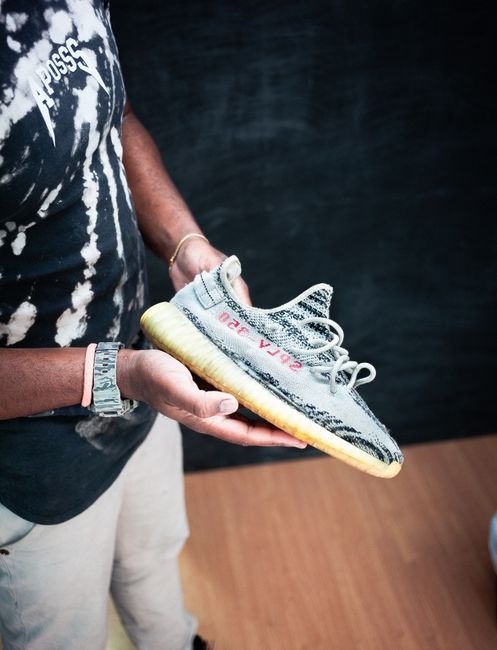
The resulting Yeezy partnership became one of the most consequential collaborations in contemporary footwear. When the Yeezy Boost 350 arrived in 2015, it immediately established a visual vocabulary that would become synonymous with the brand: restrained colours, sculptural proportions, knitted uppers, exaggerated soles and an aesthetic that seemed to exist somewhere between utilitarian sportswear and futuristic minimalism.
The significance of Yeezy was not simply that its shoes were difficult to obtain. The products helped change what consumers expected sneakers to look like.
Sneakers had long occupied the territory of sport, streetwear and subculture. Yeezy pushed them deeper into the fashion conversation. Earth tones replaced the more conventional spectacle of bright athletic footwear. Familiar athletic constructions were reinterpreted through softer, more sculptural forms. The sneaker became less about performance and more about silhouette, identity and cultural status.
That shift proved extraordinarily powerful.
By the end of the 2010s, Yeezy had become a global commercial force, generating substantial revenue for Adidas while turning West into one of the most commercially influential creative figures in fashion. His success demonstrated something the industry had previously understood only in fragments: a musician could become a designer, a designer could become a brand, and a brand could become a cultural ecosystem.
Yeezy was no longer simply a footwear line.
It was a language.
When Collaboration Becomes Control
The very qualities that made the partnership successful also contained the seeds of its eventual instability.
Yeezy depended heavily on Kanye West's creative identity. That gave the brand an authenticity that conventional corporate fashion campaigns often struggle to manufacture. But it also created an unusual relationship between an individual creator and a multinational corporation.
West increasingly demanded control over the way the brand was developed, marketed and released. Public disagreements emerged over product launches, business decisions and the degree of influence Adidas exercised over Yeezy.
The tension became increasingly visible.
Social media transformed what might once have remained private negotiations into a public running commentary. West criticised Adidas and its executives, questioned decisions surrounding Yeezy products and accused the company of appropriating elements of his creative work. Adidas, meanwhile, was operating a global business with shareholders, employees, retailers, legal obligations and brand considerations extending far beyond the wishes of a single creative partner.
The contradiction was becoming impossible to ignore.
Yeezy needed Kanye's creative authority to remain Yeezy. Adidas needed the partnership to function within the structures of a multinational corporation.
For years, the commercial success of the relationship allowed those opposing forces to coexist.
Eventually, they could not.
The Collapse
By 2022, the relationship had moved beyond creative disagreement and into a much larger corporate and reputational crisis.
West's increasingly controversial public statements, including antisemitic remarks, placed Adidas under intense pressure. The company faced a decision that was no longer primarily about product launches, sales forecasts or creative control. It had become a question of whether the commercial value of Yeezy could continue to justify the reputational and ethical consequences of maintaining the relationship.
On October 25, 2022, Adidas announced that it was ending its partnership with Ye, effective immediately.
The decision instantly transformed one of the most successful collaborations in fashion into one of its most dramatic cautionary tales.
The commercial consequences were enormous. Adidas was left with substantial quantities of Yeezy inventory and faced significant financial repercussions, while West lost the corporate infrastructure that had helped turn Yeezy into a global business. His billionaire status, which had been closely associated with the value of his business relationships and brand empire, was subsequently lost.
But the financial story was only one part of the fallout.
The more significant change was philosophical.
For years, the fashion industry had increasingly embraced the idea of the celebrity creative director: the individual whose personality, cultural relevance and personal mythology could inject energy into a global brand. Yeezy represented one of the most extreme expressions of that model.
Its collapse forced the industry to confront the risks inherent in giving a single personality enormous creative and commercial influence.
The Inventory Left Behind
The end of the partnership did not mean that Yeezy products simply disappeared.
Adidas remained in possession of existing Yeezy stock, creating an extraordinary situation for a company that had just severed ties with the person whose name was attached to the products. Over the following years, Adidas explored different approaches to selling the remaining inventory, including releases designed to generate revenue while navigating the complicated question of what the Yeezy name represented after the partnership had ended.
It was an unusual chapter in fashion history: a global sportswear company attempting to monetise one of its most commercially successful product franchises after publicly breaking with the creative figure at its centre.
The shoes themselves had become almost detached from their creator.
A Yeezy sitting on a shelf was simultaneously a piece of footwear, a commercial asset and a fragment of a complicated cultural history.
What Yeezy Changed
The influence of Yeezy extends far beyond its own sales figures.
Its greatest legacy may be the way it changed the visual language of contemporary footwear. The dominance of minimalist colour palettes, oversized proportions, knit constructions, foam-based footwear and deliberately unconventional silhouettes can be traced through much of the sneaker market that followed.
The Yeezy phenomenon also accelerated the convergence of fashion and entertainment.
West demonstrated that cultural influence could be converted into product demand at extraordinary scale. His audience was not merely buying a shoe; it was participating in a world constructed around a creative personality. The distinction between designer, celebrity and brand became increasingly difficult to define.
That model has since become deeply embedded in contemporary fashion.
But Yeezy's legacy contains an equally important lesson about the limits of personality-driven branding.
A corporation can amplify a creative vision with capital, manufacturing, logistics and distribution. But the same corporate infrastructure also exists to manage risk. The more a brand becomes inseparable from an individual personality, the more vulnerable the business can become to the actions and reputation of that individual.
Yeezy exposed that tension on an unprecedented scale.
The End of an Era
There is something almost cinematic about the trajectory of Yeezy and Adidas. A musician searching for creative freedom found a global manufacturing partner willing to take an enormous gamble. Together they produced a product ecosystem that reshaped sneaker culture and influenced the wider fashion industry.
For a time, the arrangement seemed almost perfectly engineered.
Then the personalities, commercial interests and institutional responsibilities that had driven the partnership apart became impossible to reconcile.
The Yeezy-Adidas era therefore occupies a peculiar place in fashion history. It was neither simply a success nor simply a failure. It was an extraordinary experiment in what happens when individual creative vision is given the industrial machinery of a global corporation.
At its height, Yeezy demonstrated the extraordinary power of that combination.
At its collapse, it revealed its fragility.
The shoes remain. The silhouettes remain. The influence remains visible throughout contemporary fashion. But the partnership itself belongs to another era—one that demonstrated, perhaps more clearly than any collaboration before it, that in modern fashion, creativity can build a global empire, while the relationship between creativity, celebrity and corporate power can just as quickly bring one to an end.
Tags: Kanye West Adidas Yeezy Sneaker Culture Streetwear Fashion Collaboration Boost 350 High Fashion Sneaker History Business Partnership